Thursday, August 23, 2018

Millenial Mode

Three truths:
  1. Language is always changing, and nothing can stop it. 
  2. Some of those changes may seem unnecessary or problematic to some people. 
  3. Many times our issues are indefensible linguistically, but we have them nonetheless.
Millennials have created or adopted a few discourse "fillers" that are always marked to me, even though I cannot explain why. (Remember that we all have linguistic "pet peeves" that can't be justified through the lens of sociolinguistics. Still...we are all human!) Not only are my issues unfounded, they deal with fillers that are on their surface quite friendly and inclusive. Why would they bother me if they actually serve to make connections between the speaker and the interlocutor? I will continue to try to figure out what my problem is with them, but in the end, I know I must just get used to them. In time, I suspect they will no longer seemed marked at all.

Some millennial fillers:
  1. Using "So..." to start a sentence. Example:
    • Interviewer: "You've done a lot of research on gender and language. What do the latest studies tell us in regards to gender and the use of taboo language?
    • Guest: "So...many studies find that the gap between men and women in this regard is rapidly lessening."
  2. Using "I mean..." to start a sentence, especially when there is no need for clarification. Example:
    • Professor: "Welcome to the class, Jessica. We're talking about African American English. Do you have any friends who speak this dialect?"
    • Jessica (the first thing she ever says to this professor): "I mean...I do have some friends who speak it, but only in informal situations."
  3.  Ending multiple sentences with the tag "right?" If I hear it in a setting where someone is trying to teach something to someone, or make sure they are following the conversation (known as a comprehension check in the education world), it doesn't stand out. It only gets my attention if it's a situation where a person is telling something to someone who doesn't have much (or any) prior knowledge of the topic. Example:
    1. Speaker 1: "I want to tell you what I learned about the Appalachian dialect in class today. So, it turns out that the dialect traces its roots back to the British Isles, right?"
    2. Speaker 2: "I don't know, you tell me...you're the one who learned about it!"

Sunday, August 19, 2018

A lie by any other name...

Many newscasters, pundits, and and others speaking on television and radio about the president reference his apparent difficulties with the concept of truth. A few of the more creative ways it's been described:
  • "strains credulity"
  • "on-again, off-again relationship with the truth"
  •  "demonstrable falsehood"
  • "flagrant disregard for the truth"

(more to come...)

You're Never Too Old To Learn...

Despite my having studied language and linguistics for decades, I'm always running across new words, or words that are new to me at least. A few recent examples:
  • "Jurist" as a synonym for "juror"
  • "falsity" as a synonym for "falsehood"
  • "Usurper" is a word often used on Game of Thrones. I recently heard a related word for first time, however, which is "usurpation." Both are nouns, but one is a person, and the other is the action that person does. (The usurper practices usurpation.)
  • The word "vog" as an actual word scientists use to describe volcanic smog

Miscellaneous (Probably) Never-Before-Uttered Phrases

(I'll be adding to this list as the semester progresses, so check back often!)
  • Me while having difficulty shucking corn: "These corn silks had split ends."
  • My husband, referring to our cat, Opal: "Her reactions aren't fight or flight, they're fight, flight, or flop."
  • Anderson Cooper referring to Trump's "unrequited collusion"
  • John Oliver in a report about how Facebook's stock dropped by a number that equals the entire world cheese industry's value, "Facebook stock dropped by the concept of cheese." 
  • Jeffrey Toobin on CNN when someone defends Trump for just being Trump, "Federal law does not have an exception for people with colorful personalities."  
  • Rudy Giuliani speaking about Michael Cohen on Cuomo Primetime on CNN, "Anyone can Judas." (referring to the act of betrayal) 
  • Bill Browder on CNN, "Russia has a history of extra-territorial assassination." 
  • Betsy DeVos, "I have never intentionally visited schools that are under-performing." (Have you done it unintentionally, Betsy???)
  • Sheldon on the Big Bang Theory, "What it is is a cacophonous assault of eucalyptus, bayberry, cinnamon, and vanilla...it's as if my head were trapped inside the pijamas of a sultan."
  • Gene on Bob's Burgers, "It's like Avenue Q meets Caligula meets a fight outside of a Dairy Queen." 
  • Gene on Bob's Burgers speaking about a mansion, "I'm going to buy it as a vacation home for my ferrets!"
  • Stewie on Family Guy speaking about making a commercial for an investment company, "We're there for you when your baby marries his dog dad."
  • Homer Simpson on "The Simpsons": "Chewing your leg is not a yes...I learned that in a real estate deal."
  • Chris Hardwick on the no-longer-running show "@midnight" about Taylor Swift: "You dance like an unattended fire hose."
     

Creative Morphology

A person in my life -- who shall remain unnamed -- has a very interesting way of combining words to make unconventional new words. For the vast majority of instances, it is not something done consciously, or to be clever. Some examples:
  • "disconcerning" ( = concerning + disconcerting)
  • "disparagy" (disparity + disparaging)
  • referring to ferrets: "muscalins" ( = mustelids + musky? mescaline??)
This person also pronounces several words in a way I consider to be incorrect, as the result is actually an entirely different word. He points out that I teach about the importance of maintaining home dialects, but since these actually cause confusion, I maintain that it is more than just a different way to pronounce things. Some examples:
  • "Dingo" Fever (for Dengue Fever) 
  • "Robinson Road" (for Robison Road)
  • "Darleks" (for the Daleks on Doctor Who)
  • mixing up the word for the Brazilian liquor "Cachaça" with the capital city of the Democratic Republic of the Congo, "Kinshasa"

More examples to be posted soon...

Mixed Goodies from The Daily Show

I try to watch Trevor Noah's Daily Show regularly. I always have a notepad or my phone by me so I can jot down little linguistic gems from the show, and I always manage to get at least 4 good tidbits. From the most recent episodes:
  • Trevor was lamenting the tragic situation happening with family separation at the border. He noted that some news outlets were describing "Tender Age Shelters," stating, "[It's] a hell of a fancy way to pronounce "baby jail"...it's a real euphemism, like calling a cross burning a "meatless barbecue." 
  • Trevor described Devin Nunez as having "Resting Middle Management Face" (based off of Resting Bitch Face)
  • Trevor noted a recent euphemism for human trafficking, "economic migration." This is an example of gross understatement, and does the public a great disservice by lessening the gravity of what is being discussed. 
  • Trevor had the star from Black Panther on one evening, and they spent some time talking about the actor's work with a dialect coach. The main dialect used is the Xhosa, which is an official language of South Africa perhaps best known for its "click consonants". Omniglot has some basic information on the pronunciation of the language, along with some videos where you can hear the language being spoken: https://www.omniglot.com/writing/xhosa.htm. Here is a link to an interview with that coach: https://slate.com/culture/2018/02/an-interview-with-black-panthers-dialect-coach.html
  • Trevor centered one of his segments around "The I-Word." We've used that abbreviation technique  to avoid saying the full versions of "The F-Word" and the The N-Word," but in this case, the word in question is IMPEACHMENT.

Wednesday, March 28, 2018

Fun Idiom Websites

I have been reading journal posts by my Spring 2018 Introduction to Sociolinguistics students, and they have been not only encouraging, but inspiring. Thanks to them, I found some great websites -- both academic and humorous. I'll list a few here, and add more as I run across them:


The Cream of the Crop: Have you ever noticed how many English idioms are based on food?
http://examples.yourdictionary.com/examples-of-food-idioms.html


He Who Smelt It, Dealt It...and dozens of variations:
http://werbach.com/stuff/smelt.html


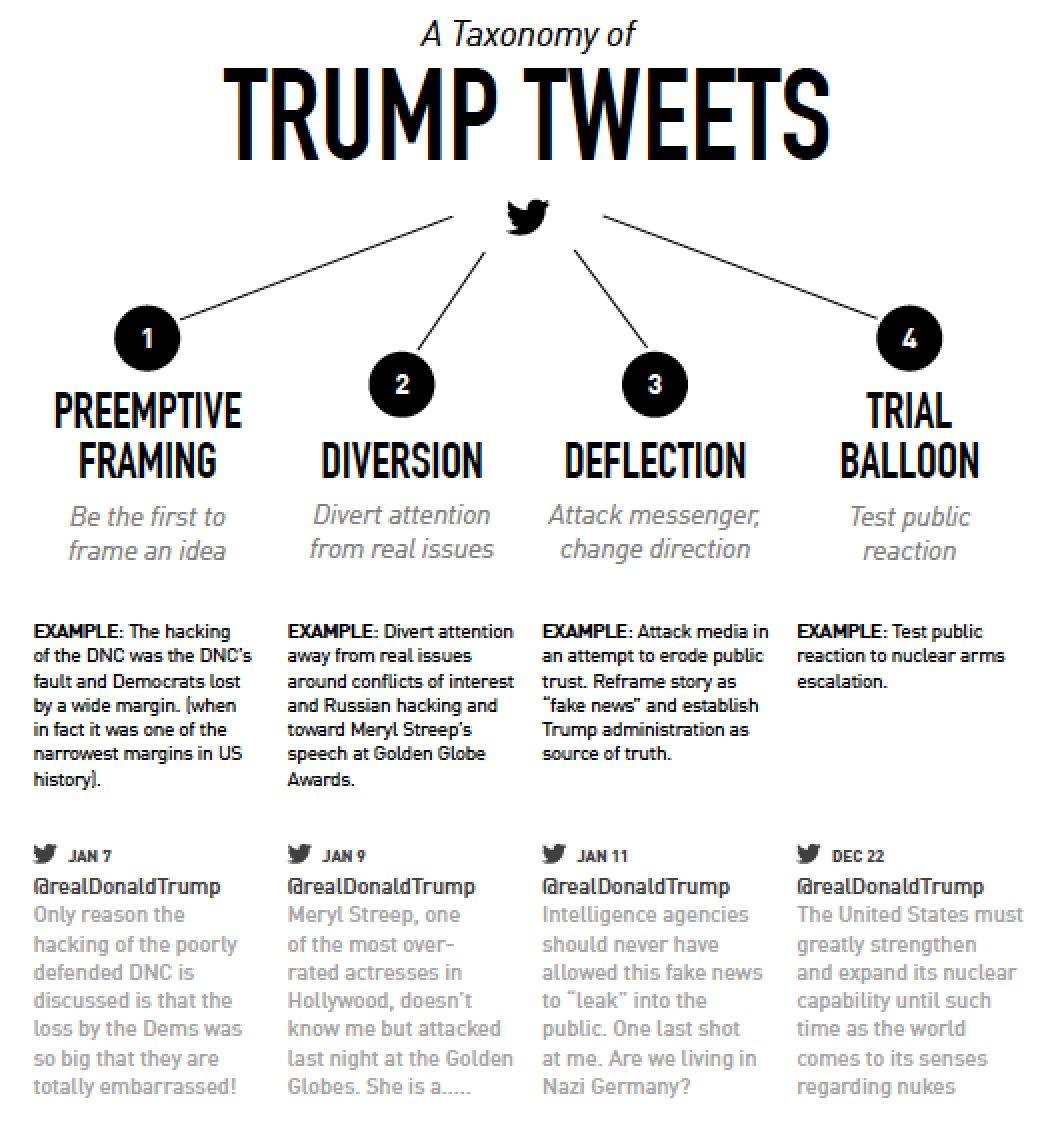
Trump Speak

(I will be adding to this post as the semester progresses...) For a sociolinguist, President Trump's tweets are a treasure trove of l...