Thursday, August 23, 2018

Trump Speak

(I will be adding to this post as the semester progresses...)

For a sociolinguist, President Trump's tweets are a treasure trove of linguistic oddities. There are several traits he has become known for:
  • the use of nicknames (I have a separate post on this)
  • the use of superlatives (best, smartest, greatest, biggest, etc.)
    • "Nobody has been tougher on Russia than me."
    • "Nobody builds better wall than I do."
    • “I know words...https://news.liverpool.ac.uk/2018/01/19/one-year-trump-linguistics-expert-analyses-us-presidents-influence-language/https://qz.com/1153080/trump-tweets-analyzed-by-linguists-reveal-five-characteristics/I have the best words.”
  • the use of negative hyperbole 
    • "The worst FBI director in our history" 
    • "They will be met with fire and fury like the world has never seen.”
    • "The worst trade deal ever made."
  • a lack of complex vocabulary, favoring a small set of words used over and over, such as the frequent use of "Sad!"
  • the use of future progressive tense
    • "You're going to be seeing..."
    • "We're going to be looking at..."
    • "They're going to be asking..."
  • the use of hedges, or backtracking
    •  “Hillary wants to abolish, essentially abolish the Second Amendment.” 
    • "Certainly there was meddling. Probably there was meddling from other countries."
  • the use of apophasis, which is a figure of speech typically used to bring up a taboo subject by either denying it or pretending to pass over it:
    • “I was going to say ‘dummy’ Bush; I won’t say it. I won’t say it,”
    • “I promised I would not say that she ran Hewlett-Packard into the ground, that she laid off tens of thousands of people and she got viciously fired. I said I will not say it, so I will not say it.” 
  • the use of  parataxis and/or hyptotaxis, which is the stringing of simple clauses together in a jumble (a run-on sentence):
    • "...my uncle was a great professor and scientist and engineer, Dr. John Trump at M.I.T.; good genes, very good genes, O.K., very smart, the Wharton School of finance, very good, very smart – you know, if you're a conservative Republican, if I were a liberal, if, like, okay, if I ran as a liberal Democrat, they would say I'm one of the smartest people anywhere in the world – it’s true! – but when you're a conservative Republican they try – oh, they do a number – that’s why I always start off: "Went to Wharton, was a good student, went there, went there, did this, built a fortune”– you know I have to give my life credentials all the time, because we're a little disadvantaged – but you look at the nuclear deal, the thing that really bothers me …
  • the use of vague sentences with no antecedent
    • "When you look at what they've been doing, it's very unfair." (What exactly is he referring to? Who are THEY?)
    • "When you see what they've been doing over there.." (who and what?)
    •  "Everybody's saying it..." (who?)
MORE TO BE ADDED SOON...


Here are a few brief (some informative, some entertaining, some both) news stories focusing on his use of language, both spoken and written. (I'll be adding to this collection as the semester progresses.)
  • Jeannie Moos of CNN: 
    • Trump's Curious Case of Going with Uppercase: https://www.cnn.com/videos/politics/2018/05/07/capital-trump-twitter-moos-pkg.cnn
    • Trump's Typos: https://www.cnn.com/videos/politics/2018/03/21/donald-trump-tweet-typos-moos-pkg-erin.cnn
  • (from a guest on Anderson Cooper's 360) Trump's use of forceful and easy-to-remember phrases with two words, often mono-syllabic:
    • "fake news"
    • "witch hunt"
    • "deep state"
    • "Spy-gate"
    • "not good"
    • "fire & fury" 
    • "believe me"
    • NOTE: One study found that 78% of Trump's words are monosyllabic
More linguistic analysis you might find interesting:
  • A fascinating set of "word clouds": https://www.nbcnews.com/politics/2016-election/donald
  • https://www.vox.com/policy-and-politics/2017/1/11/14238274/trumps-speaking-style-press-conference-linguists-explaintrump-s-campaign-tweets-n593846
  • https://www.washingtonpost.com/news/the-fix/wp/2017/07/07/this-linguist-studied-the-way-trump-speaks-for-two-years-heres-what-she-found/?utm_term=.f9b6444f44f0 
  • https://qz.com/1153080/trump-tweets-analyzed-by-linguists-reveal-five-characteristics/
  • https://www.cnn.com/2017/04/21/politics/donald-trump-president-speeches-favorite-phrases-trnd/index.html
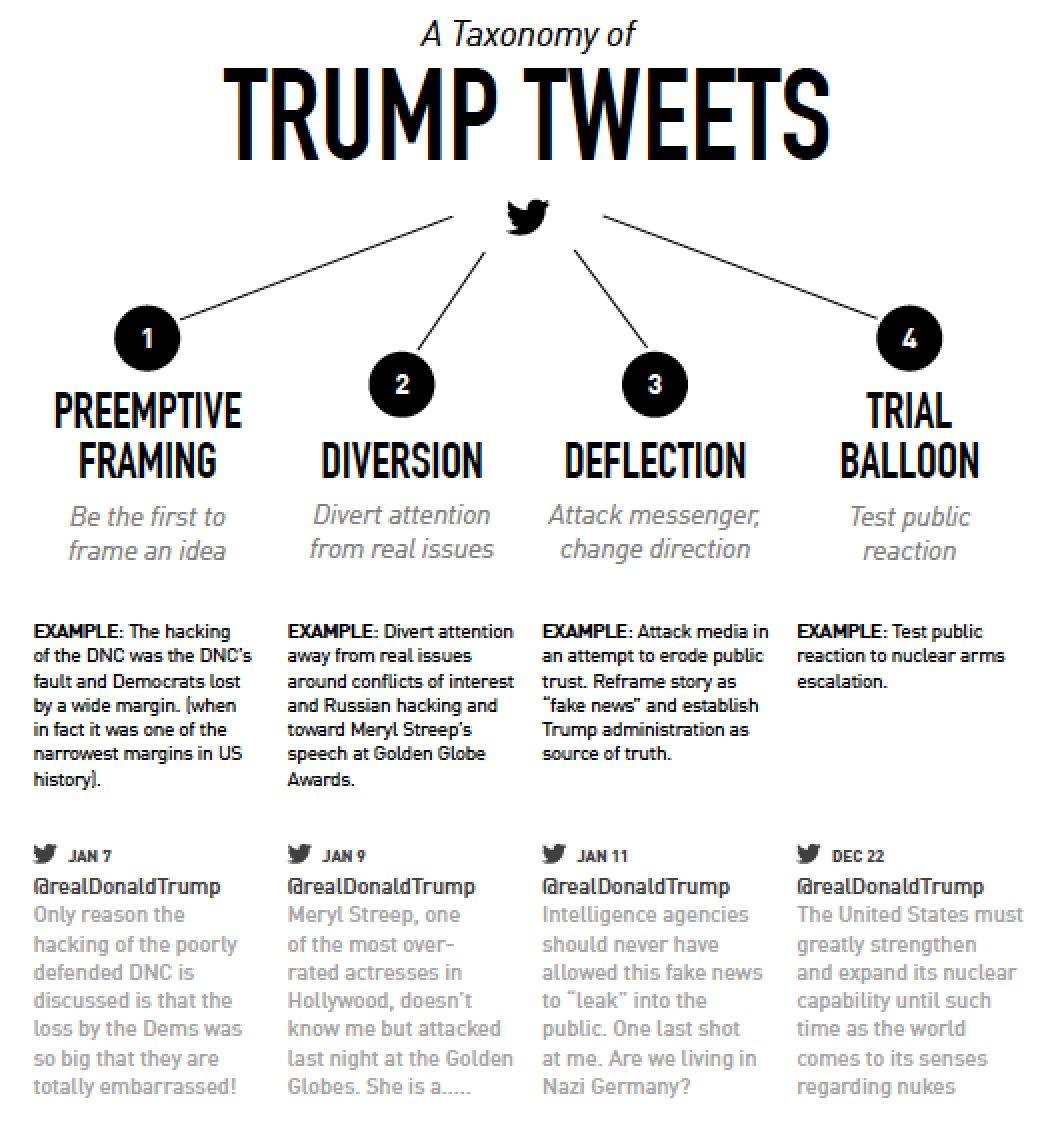
  • Linguist George Lakoff: https://www.fastcompany.com/90155999/graphic-trumps-tweets-can-be-reduced-to-4-rhetorical-strategies (see graphic below)
Clever Commercials

I'm going to start a running list of interesting linguistic tidbits from television commercials:
  • A commercial for cat litter ends with this line, "Don't change the litter; change the litter." Just seeing the words visually rather than hearing them gives no clue to the context, therefore making the statement ambiguous at best, and confusing at worst. In the commercial, however, the viewer gets to hear the voice-over speaker's changes in emphasis and volume, which are two important para-linguistic variables. When you hear the changes, it becomes clear that the intended meaning is "You don't have to change the cat litter so much (change = cleaning) if you switch to our brand of cat litter (change = switch.) When we are used to a phrase such as "change the litter," we usually have no problem determining meaning from the context. When the verb "change" is used in two distinct ways in one sentence, however, the para-linguistic variables are the key to comprehension. 
  •  Another current commercial is sort of the opposite in how it works. The spoken words leave some ambiguity, while the written form that is put on the screen at the end reveals the meaning: "If you got a life, you gotta Swiffer." Pronounced quickly, "got a" and "gotta" are homophones (two words pronounced identically). The first, however, is a contraction of "got a" (also notice that the "you" is a shortened informal version of "you've"), while the other is a spoken contraction for "got to," as in "have to." The trick wouldn't work at all if the voice-over said, "If you have a life, you have to Swiffer." 

more to come...

Millenial Mode

Three truths:
  1. Language is always changing, and nothing can stop it. 
  2. Some of those changes may seem unnecessary or problematic to some people. 
  3. Many times our issues are indefensible linguistically, but we have them nonetheless.
Millennials have created or adopted a few discourse "fillers" that are always marked to me, even though I cannot explain why. (Remember that we all have linguistic "pet peeves" that can't be justified through the lens of sociolinguistics. Still...we are all human!) Not only are my issues unfounded, they deal with fillers that are on their surface quite friendly and inclusive. Why would they bother me if they actually serve to make connections between the speaker and the interlocutor? I will continue to try to figure out what my problem is with them, but in the end, I know I must just get used to them. In time, I suspect they will no longer seemed marked at all.

Some millennial fillers:
  1. Using "So..." to start a sentence. Example:
    • Interviewer: "You've done a lot of research on gender and language. What do the latest studies tell us in regards to gender and the use of taboo language?
    • Guest: "So...many studies find that the gap between men and women in this regard is rapidly lessening."
  2. Using "I mean..." to start a sentence, especially when there is no need for clarification. Example:
    • Professor: "Welcome to the class, Jessica. We're talking about African American English. Do you have any friends who speak this dialect?"
    • Jessica (the first thing she ever says to this professor): "I mean...I do have some friends who speak it, but only in informal situations."
  3.  Ending multiple sentences with the tag "right?" If I hear it in a setting where someone is trying to teach something to someone, or make sure they are following the conversation (known as a comprehension check in the education world), it doesn't stand out. It only gets my attention if it's a situation where a person is telling something to someone who doesn't have much (or any) prior knowledge of the topic. Example:
    1. Speaker 1: "I want to tell you what I learned about the Appalachian dialect in class today. So, it turns out that the dialect traces its roots back to the British Isles, right?"
    2. Speaker 2: "I don't know, you tell me...you're the one who learned about it!"

Sunday, August 19, 2018

A lie by any other name...

Many newscasters, pundits, and and others speaking on television and radio about the president reference his apparent difficulties with the concept of truth. A few of the more creative ways it's been described:
  • "strains credulity"
  • "on-again, off-again relationship with the truth"
  •  "demonstrable falsehood"
  • "flagrant disregard for the truth"

(more to come...)

You're Never Too Old To Learn...

Despite my having studied language and linguistics for decades, I'm always running across new words, or words that are new to me at least. A few recent examples:
  • "Jurist" as a synonym for "juror"
  • "falsity" as a synonym for "falsehood"
  • "Usurper" is a word often used on Game of Thrones. I recently heard a related word for first time, however, which is "usurpation." Both are nouns, but one is a person, and the other is the action that person does. (The usurper practices usurpation.)
  • The word "vog" as an actual word scientists use to describe volcanic smog

Miscellaneous (Probably) Never-Before-Uttered Phrases

(I'll be adding to this list as the semester progresses, so check back often!)
  • Me while having difficulty shucking corn: "These corn silks had split ends."
  • My husband, referring to our cat, Opal: "Her reactions aren't fight or flight, they're fight, flight, or flop."
  • Anderson Cooper referring to Trump's "unrequited collusion"
  • John Oliver in a report about how Facebook's stock dropped by a number that equals the entire world cheese industry's value, "Facebook stock dropped by the concept of cheese." 
  • Jeffrey Toobin on CNN when someone defends Trump for just being Trump, "Federal law does not have an exception for people with colorful personalities."  
  • Rudy Giuliani speaking about Michael Cohen on Cuomo Primetime on CNN, "Anyone can Judas." (referring to the act of betrayal) 
  • Bill Browder on CNN, "Russia has a history of extra-territorial assassination." 
  • Betsy DeVos, "I have never intentionally visited schools that are under-performing." (Have you done it unintentionally, Betsy???)
  • Sheldon on the Big Bang Theory, "What it is is a cacophonous assault of eucalyptus, bayberry, cinnamon, and vanilla...it's as if my head were trapped inside the pijamas of a sultan."
  • Gene on Bob's Burgers, "It's like Avenue Q meets Caligula meets a fight outside of a Dairy Queen." 
  • Gene on Bob's Burgers speaking about a mansion, "I'm going to buy it as a vacation home for my ferrets!"
  • Stewie on Family Guy speaking about making a commercial for an investment company, "We're there for you when your baby marries his dog dad."
  • Homer Simpson on "The Simpsons": "Chewing your leg is not a yes...I learned that in a real estate deal."
  • Chris Hardwick on the no-longer-running show "@midnight" about Taylor Swift: "You dance like an unattended fire hose."
     

Creative Morphology

A person in my life -- who shall remain unnamed -- has a very interesting way of combining words to make unconventional new words. For the vast majority of instances, it is not something done consciously, or to be clever. Some examples:
  • "disconcerning" ( = concerning + disconcerting)
  • "disparagy" (disparity + disparaging)
  • referring to ferrets: "muscalins" ( = mustelids + musky? mescaline??)
This person also pronounces several words in a way I consider to be incorrect, as the result is actually an entirely different word. He points out that I teach about the importance of maintaining home dialects, but since these actually cause confusion, I maintain that it is more than just a different way to pronounce things. Some examples:
  • "Dingo" Fever (for Dengue Fever) 
  • "Robinson Road" (for Robison Road)
  • "Darleks" (for the Daleks on Doctor Who)
  • mixing up the word for the Brazilian liquor "Cachaça" with the capital city of the Democratic Republic of the Congo, "Kinshasa"

More examples to be posted soon...

Mixed Goodies from The Daily Show

I try to watch Trevor Noah's Daily Show regularly. I always have a notepad or my phone by me so I can jot down little linguistic gems from the show, and I always manage to get at least 4 good tidbits. From the most recent episodes:
  • Trevor was lamenting the tragic situation happening with family separation at the border. He noted that some news outlets were describing "Tender Age Shelters," stating, "[It's] a hell of a fancy way to pronounce "baby jail"...it's a real euphemism, like calling a cross burning a "meatless barbecue." 
  • Trevor described Devin Nunez as having "Resting Middle Management Face" (based off of Resting Bitch Face)
  • Trevor noted a recent euphemism for human trafficking, "economic migration." This is an example of gross understatement, and does the public a great disservice by lessening the gravity of what is being discussed. 
  • Trevor had the star from Black Panther on one evening, and they spent some time talking about the actor's work with a dialect coach. The main dialect used is the Xhosa, which is an official language of South Africa perhaps best known for its "click consonants". Omniglot has some basic information on the pronunciation of the language, along with some videos where you can hear the language being spoken: https://www.omniglot.com/writing/xhosa.htm. Here is a link to an interview with that coach: https://slate.com/culture/2018/02/an-interview-with-black-panthers-dialect-coach.html
  • Trevor centered one of his segments around "The I-Word." We've used that abbreviation technique  to avoid saying the full versions of "The F-Word" and the The N-Word," but in this case, the word in question is IMPEACHMENT.

Wednesday, March 28, 2018

Fun Idiom Websites

I have been reading journal posts by my Spring 2018 Introduction to Sociolinguistics students, and they have been not only encouraging, but inspiring. Thanks to them, I found some great websites -- both academic and humorous. I'll list a few here, and add more as I run across them:


The Cream of the Crop: Have you ever noticed how many English idioms are based on food?
http://examples.yourdictionary.com/examples-of-food-idioms.html


He Who Smelt It, Dealt It...and dozens of variations:
http://werbach.com/stuff/smelt.html


Friday, March 23, 2018

The prejudice is like totally unfair!

Image result for linguist filler words like

http://allthingslinguistic.com/post/158127068386/lets-stop-demonizing-filler-words

But isn't it, like, a good idea to, like, try to, like, avoid it in, like, academic or professional settings?

Discuss.

The cheese done slid off my cracker

One of my students recently brought a phrase to my attention having to do with cheese sliding off of a cracker. I had never heard it, so I googled it. I was surprised at how many things showed up on the images page...it looks like we've been missing out on a good one! I am posting this particular image because it also includes the past tense marker "done" that we'd been seeing in the Appalachian dialect we were studying in class. "I think this boy's cheese has done slid off his cracker."

Now I want cheese and crackers.

Monday, March 12, 2018

"Just Say it Like it's Spelled..."

In class I often talk about how stupid that statement is when it refers to English. English may have the single least phonetic language on the planet, with numerous examples of the lack of correspondence between symbol and sound. We know it's due to English taking words from other languages and keeping the spelling, but it's really quite remarkable when you think about it. I cannot imagine learning English spelling as a non-native speaker!

  • Words that rhyme: ache, break, and stake are all spelled very differently, but their IPA representation shows how close they are in pronunciation [eik] [breik] [steik]
  • Another unlikely rhyming pair from The Simpsons: "Sardine Queen" [sardin] [kwin]

I'll keep adding to this list...

John Oliver Describes Mt. Dew

In his Feb. 2018, 2018 show, Last Week Tonight, host John Oliver creatively describes America as being "a beautiful mess of contradictions." He explains further, offering:

"As an immigrant who has fallen in love with this country, for what it's worth, please allow me to speak to the rest of the world in America's defense, Donald Trump does not represent America — well, to be completely honest, he does reflect it a bit. But the point is America is not one thing; it's a beautiful mess of contradictions where good and bad are mixed together. For instance, it makes Mountain Dew, which tastes like a honeydew melon was fucked by a radioactive cloud.  On the other hand, it makes awesome beds shaped like the Batmobile." 

He continued, "America is the country that gave you Star Wars — you're welcome — and Scientology — we're sorry about that. And sometimes, what's great and terrible about us is just impossible to separate."


"Deconflicting" Military Euphemisms

A CNN commentator used the word deconflict. It was clear that the word had to do with lessening some sort of conflict, but I had never heard the word before. Here's a dictionary entry on the word, which was first used sometime between 1970-1975.

 
DECONFLICT
verb (used with object)
1.
Military.
  1. to avoid a potential clash or accident involving (nonenemy military operations, weaponry, etc.) in a particular combat area:
    to deconflict coalition forces from three nations.
  2. to avoid such conflict in (a combat area):
    to deconflict airspace.
2.
to adjust or coordinate so as to prevent or resolve conflict:
The witness never explained or deconflicted his earlier statements.
 
I wanted to do a little more digging on the word's usage. A 2015 article in the Guardian took a negative prescriptive view of the word, stating:  
 
"With the launching of Russian air strikes in Syria this week, the already brutal conflict has taken another ugly and awkward turn – and it has thrown up a new ugly and awkward word to match.The word “deconflict” – or worse “deconfliction” – is being used by US officials to describe attempts to ensure that US and Russian air forces don’t shoot at each other while they conduct overlapping air campaigns over Syria."

The author spoke to Gary Rawnsley, a professor of public diplomacy at Aberystwyth University: 

“It’s meaningless,” he said. 'It’s one of those phrases like ‘collateral damage’ that militaries use to soften the blow of their activities.'

More from the same article:

"It was first noted as Pentagon jargon by the Guardian in 1991 during reports on the Gulf war. The paper carried a Gulf-English dictionary which gave this definition of deconfliction as 'trying not to have so many planes in the air that they collide'.

It was also a favourite of Donald Rumsfeld, the master of Pentagon doublespeak. In 2006, he came out with this sentence to defend US strategy in Iraq: 'We’ve gone from ... service-centric warfighting to deconfliction warfighting to interoperability and now towards interdependence.'

The verb deconflict has been included in the Oxford English Dictionary since 2005. It provides this definition: To reduce the risk of collision in (a combat situation, airspace, etc) by separating the flight paths of one’s own aircraft or airborne weaponry. Also: to coordinate (one’s aircraft) in this manner."
 
 
Guardianhttps://www.theguardian.com/us-news/2015/oct/01/deconflict-buzzword-to-prevent-risk-of-a-us-russian-clash-over-syria

Common the Rapper on Family Feud?

Last week's Saturday Night Live featured actor Sterling K. Brown as the host. In one skit, he portrays the rapper Common as a contestant on the Family Feud Show. SNL cast member Keenan Thompson plays the host of the show, Steve Harvey.

Common's character answers pretty much every question in rap style. The best was, “Blessings, yo. It’s an honor to be a part of this family. Despite our feud we still put food on the table, provide for the children, make sure their futures are stable."

The response from Thompson's Steve Harvey was, “Yeah, okay. OK. Let’s just slow it down there, Dr. Martin Luther Seuss."

Drunk History and the Oxford Dictionary

Image result for W.C. Minor oxford

My husband and I enjoy watching a TV show called "Drunk History." The show involves 10-15 minute segments of inebriated guests (who continue to imbibe as they talk) relating a story from various time periods and global locations. As amusing as it is to watch the guests and the hosts getting more and more intoxicated, we actually end up learning things.

The episode Dangerous Minds included a segment on Dr. William Minor, who (among many other interesting accomplishments) helped write a large chunk of the Oxford Dictionary. Dr. Minor was a deeply troubled individual, spending time in both asylums and prisons. After killing a man during a paranoid mental break around 1871, Minor was admitted to the Asylum for the Criminally Insane in Broadmoor in England. Surprisingly, one of his frequent visitors at the asylum was the wife of the man he had killed. They developed a bond, and she often brought or sent him piles books to read. in one of those piles, he found a notice from James Murray, who was seeking volunteers to help create the first Oxford English Dictionary. He spent more than 20 more years in the asylum, writing tens of thousands of entries for the dictionary.

If you'd like to read more about W.C. Minor and his role in the compilation of the Oxford English Dictionary, this is a good start: https://www.ozy.com/flashback/the-lunatic-behind-the-dictionary/64787

Friday, January 26, 2018

Presidential Nicknames

A new linguistic term for you:
Onomastics: the study of names

I'm not sure any other world leader has inspired so many creative nicknames at President Trump has. There is even a webpage dedicated to them: https://www.findnicknames.com/nicknames-for-donald-trump/ 

NOTE: Some may take offense to this and call it disrespectful to the President in particular, or to the office of the presidency in general. Given his use of nicknames for his rivals, I don't have much sympathy for this position.

 I'm going to keep a running list of my favorites here...
  • Rage Against the Tangerine (Trevor Noah)
  • Cinnamon Hitler (Trevor Noah)
  • Cheeto Jesus
  • Butterscotch Frog
  • Circus Peanut
  • Malevolent Creamsicle 
  • Agent Orange
  • Assaulter-in-Chief
  • Captain Chaos
  • Cheez Doodle
  • Bratman
  • and... The Human Tanning Bed Warning Label 
  • NEW: Mango Unchained

a bonus nickname for Jeff Sessions: Confederate Hobbit
a recent name for Trump's base: Trumpanzees

Speaking of disrespectful, there is also, of course, a long list of nicknames that President Trump has given to other people. Wikipedia actually has a dedicated page: https://en.wikipedia.org/wiki/List_of_nicknames_used_by_Donald_Trump. Here are some highlights:

  • Crooked Hillary
  • Little Rocketman
  • Sloppy Steve (Bannon)
  • Leakin' James Comey
  • Jeff Flakey
  • Sneaky Dianne Feinstein 
  • Al Frankenstein
  • Crazy Bernie
  • Cryin' Chuck (Schumer)
  • and the ethnically insensitive "Pochahontis" for Elizabeth Warren

Random TV Quotes

As usual, I find that Fox animation is a veritable gold-mine for (probably) never-before-uttered sentences:

FAMILY GUY:
  • Lois to Peter: "I want you to do me so hard we have to change churches."
  • Stewie: "Mother, I come bearing a gift. I'll give you a hint: it's in my diaper and it's not a toaster."
  • Stewie, while plucking a banjo: "Oh! I feel so delightfully white trash! Mummy, I want a mullet!"
  • Peter: "Christmas is the time of year when the ghost of Jesus rises from the grave to feast on the flesh of the living and we sing Christmas carols to lull him back to sleep." 
BOB'S BURGERS:
  • Louise Belcher and Felix Fischoeder exhibit linguistic ambiguity:
    • Louise: "I need money for a dog."
    • Felix: "You owe a dog money?"
  •  Bob: "I'm just a little tired. Also, I might be a pimp."
  • Gene offers up a nice portmanteau: "[I'm wearing] trash fashion. I call it trashion."
THE SIMPSONS:
  • On Treehouse of Horror XIX, Krusty the Clown is getting ready to kill Homer when Homer asks, "What is the one true religion?" Krusty replies, "It's a mix of voodoo and Methodism."
  • Marge, talking about Bart: "There's something about flying a kite at night that's so unwholesome." 
  • Mr. Burns provides an unfortunate example of homonyms when he speaks about not wanting a woman on board a ship: "I think women and seamen don't mix."

TREVOR NOAH: (I adore the Daily Show!)
  • Trevor talking about India abolishing the Muslim law that allows men to divorce their wives simply by saying "divorce" three times: "Can you do it by text? Is it all on one text, or three separate texts? 
  • "Trump is a social pyromaniac."
  • "Roy Moore is the bibliest [baibliEst] person that ever ran for anything..." and "I've never heard anyone deny their way into a confession." (He was referring to when Moore said he doesn’t remember “dating any girl without the permission of their mother.”)
  • Lewis Black as guest commentator: "A train without a track isn't even a train...it's a hobo fuck palace!"
  • Trevor talking about the incompetence of the White House: "...sloppier than a bulldog orgy!"
  • Trevor referring to Trump lying on Twitter during a hearing about him lying on Twitter: "Trump is live-lying the hearing!"
  • Trevor had author Matt Taibbi on the show talking about his book, "Insane Clown President" (a riff on the band "Insane Clown Posse), and Taibbi said, "Consuming facts as consumers...we shop for facts the same way we shop for hats, shoes, or, you know, radial tires. We shop for things we like." Brilliant statement! 

TRULY RANDOM:
  • In the most recent season of Doctor Who, companion Bill points out that T.A.R.D.I.S. (an acronym for Time and Relative Dimension in Space) wouldn't make sense to an alien because the acronym wouldn't work in other languages. It's a running bit for all new companions to point out that the T.A.R.D.I.S. is bigger on the inside, but this is what she says instead. A surprised doctor frowns and replies, "People don't usually bring THAT up."
  • A bar sign shown on the Chris Hardwick show "@Midnight": "Due to physical violence, shit-faced Mondays have been cancelled." 
  • Chris Hardwick correctly predicted that people would be masturbating in self-driving cars, saying "I didn't mean to Nostrodamus that!" (a proper  name turned into a verb) (The linguistic term for turning nouns into verbs is actually called "verbing.") https://www.thoughtco.com/what-is-verbing-1691035
  • Chris Hardwick talking about an upcoming convention dedicated to emojis, called "Emojicon" (a great example of portmanteau!)
  • Colin Jost on Saturday Night Live referring to mild-mannered James Comey: "He looks like if the word gosh became a person."
  • Michael Che on Saturday Night Live feigning surprise, "Well, clutch my pearls!" This is actually a common dialectical phrase in the south, and there are several memes about it now, including one of my favorites:

Thursday, January 25, 2018

Latinex

Over the last few decades, there have been movements towards neutralizing the binary male-female gender system in Spanish. It has been argued that the use of masculine pronouns and endings for mixed-gender groups of people is sexist, viewing male as the "default" gender. Various suggestions have arisen, including the use of Latin@ instead of Latino or Latina. This solution is visually awkward in written form, and unpronounceable in spoken form.

In recent years, the discussion has broadened to address society's changing views on gender. We are now understanding/acknowledging that gender is a social construct, and is better viewed as a spectrum rather than a binary delineation. With people identifying as transgendered, non-binary gendered, or gender-fluid, the push for a gender-inclusive form has intensified. One option put forth (admittedly more by academics than by the general public) is Latinex (pronounced [la-ti-nEks]. Since Spanish gender applies not only to nouns, but also to articles and adjectives, the "x" ending is extended to the definite articles le and lex and the indefinite article unex. There is some disagreement on the plural vs. adjective forms, but the phrase "the Latina professors" would translate as lex profesorex latinex. [lEks-pro-fe-so-res-la-ti-nEks]

It's not surprising that there are arguments for and against adopting this form. Here are two articles voting in favor of it, but both of them discuss the English usage of the term instead of how it would work in Spanish:


This article does address the grammatical ramifications of its usage in Spanish as well as English:


https://medium.com/@puentera/latino-latinx-latine-a3b19e0dbc1c
  
This article outlines an argument against its use:


Trump Speak

(I will be adding to this post as the semester progresses...) For a sociolinguist, President Trump's tweets are a treasure trove of l...